

India’s contribution to science did not begin with the IT boom of the 1990s or the satellites ISRO now launches. Long before Europe’s Scientific Revolution, scholars, surgeons and metallurgists working in the Indian subcontinent had already worked out the mathematics of zero, described rhinoplasty in surgical detail, cast an iron pillar that has resisted rust for over 1,600 years, and laid the groundwork for algebra and formal grammar. These were not folklore or myth—they are documented in surviving Sanskrit texts, inscriptions, and, in several cases, confirmed by modern metallurgical and archaeological analysis.
This article looks only at discoveries that are backed by textual evidence, archaeological findings, or peer-reviewed research—not the exaggerated claims (ancient aircraft, “genetic engineering” in the epics, and similar viral assertions) that circulate online without credible support. Where dates are debated among historians, that uncertainty is noted rather than glossed over.
What Are the Most Well-Documented Scientific Discoveries India Made in Ancient Times?
The best-evidenced scientific and mathematical contributions from ancient and early medieval India include the decimal place-value system and the numeral zero, advanced surgical techniques recorded in the Sushruta Samhita, corrosion-resistant iron metallurgy, the earliest known statement of what is now called the Pythagorean relationship, foundational work in linguistics and formal grammar, and early ideas in atomic theory and astronomy.
Each of these is traceable to a specific text, artifact, or archaeological site, which is what separates them from unverifiable folk claims. The sections below go through each discovery, the evidence behind it, and why it mattered.
The Concept of Zero and the Decimal Place-Value System
India’s clearest and most consequential scientific contribution is the invention of zero as both a placeholder and a number, combined with the decimal place-value system still used worldwide today.
Babylonian and Mayan cultures used placeholder symbols in their number systems earlier, but neither treated zero as an independent number with its own mathematical rules. Indian mathematicians did. The astronomer-mathematician Aryabhata (born 476 CE) used a place-value system in his work Aryabhatiya (499 CE), and the mathematician Brahmagupta, writing in Brahmasphutasiddhanta (628 CE), gave the first known rules for arithmetic involving zero, including addition, subtraction, and its behavior in division. The Bakhshali manuscript, a mathematical text whose surviving birch-bark folios have been radiocarbon dated by the University of Oxford’s Bodleian Library to as early as the 3rd–4th century CE, contains one of the earliest recorded uses of a zero symbol as a placeholder, predating Brahmagupta’s formal rules.

This system spread to the Arab world through scholars such as Al-Khwarizmi, whose 9th-century texts introduced it to the Islamic world, and from there into Europe by the 12th–13th centuries—which is why these numerals are commonly called “Arabic numerals” in the West, even though their origin is Indian. Without a positional zero, the arithmetic that underlies modern engineering, computing, and finance would not function the way it does.
Why this matters today: Every digital computer represents information in binary, a positional number system. The conceptual leap of treating “nothing” as a quantifiable, operable number is the same leap that makes positional counting—and by extension, modern computing—possible.
Sushruta and Early Surgical Science
The physician Sushruta, working in the region of present-day Varanasi sometime between roughly 600 BCE and 600 CE (historians differ on the exact period, though 6th century BCE is commonly cited), authored the Sushruta Samhita, one of the world’s oldest surviving surgical treatises.
The text describes:
- Rhinoplasty (nose reconstruction): a forehead- or cheek-skin pedicle flap technique to rebuild noses amputated as punishment—a method still referred to as the “Indian method” in modern plastic surgery literature.
- Cataract surgery, using a curved needle to displace the clouded lens.
- Over 120 surgical instruments and a classification of surgical procedures, including incision, excision, and suturing.
- Wound classification and burn grading, along with descriptions of diabetes and its relationship to sweet-tasting urine, centuries before germ theory or endocrinology existed.

This is not a claim made only by enthusiasts of Indian history. The 1794 issue of The Gentleman’s Magazine in London documented a British surgeon witnessing an Indian craftsman perform a forehead-flap rhinoplasty on a bullock-cart driver named Cowasjee, whose nose had been cut off as punishment by Tipu Sultan’s forces. That eyewitness account, based on a technique passed down from the Sushruta tradition, is widely credited with reviving interest in reconstructive rhinoplasty in Europe, influencing surgeons like Joseph Constantine Carpue in England.
Important nuance: The Sushruta Samhita is a compiled and redacted text with contributions across centuries, so it should be read as a tradition of surgical knowledge rather than the output of a single identifiable individual working at one precise date.

The Iron Pillar of Delhi: Ancient Metallurgy That Still Resists Rust
Standing in the Qutb complex in Delhi, the Iron Pillar is a 7.2-metre, roughly six-tonne solid iron structure that has resisted significant rusting for over 1,600 years despite standing outdoors through monsoon seasons.
An inscription on the pillar credits a king named Chandra, generally identified by historians as the Gupta emperor Chandragupta II, dating the pillar to around 400 CE. Metallurgical research led by R. Balasubramaniam at IIT Kanpur, published in Corrosion Science (2000), found that the pillar’s resistance comes from its unusually high phosphorus content and the near-total absence of sulfur and manganese. This chemistry, combined with Delhi’s alternating wet-dry climate, allows a thin, self-renewing protective layer of iron hydrogen phosphate hydrate (“misawite”) to form on the surface, functioning similarly to modern weathering steels developed only in the 20th century.
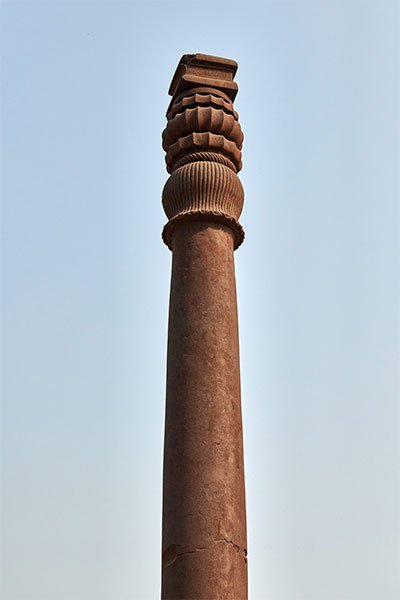
In short: ancient Indian smiths, without any understanding of modern chemistry, produced iron with a composition that happens to replicate a corrosion-resistance mechanism engineers only formalized centuries later. This was achieved through empirical craftsmanship and material selection, not a documented theoretical model—which is itself a notable historical fact about how metallurgical knowledge developed through trial and observation.
why Indian monuments have survived
Baudhayana and the Roots of Geometry
Long before Pythagoras (6th century BCE Greece) is traditionally credited with the theorem relating the sides of a right triangle, the Baudhayana Sulba Sutra—part of a set of texts on altar construction geometry, generally dated to around 800 BCE, though estimates vary among historians—contains a statement equivalent to the Pythagorean theorem, along with practical methods for constructing right angles used in temple and altar design.
This does not mean Baudhayana “invented” the theorem in the sense of a formal mathematical proof; the Sulba Sutras present it as a practical rule for construction, not a deductive proof, which is different from Euclid’s later geometric treatment. But the chronological priority and independent development of the relationship is well documented in the history of mathematics.
The Sulba Sutras also include methods for:
- Constructing squares of a given area
- Approximating the square root of 2 to a high degree of accuracy
- Transforming one geometric shape into another of equal area (a problem in ancient geometry known as “squaring”)

Panini’s Grammar: An Early Formal System
Around the 4th–5th century BCE, the grammarian Panini composed the Ashtadhyayi, a nearly 4,000-rule system that formally describes the grammar of Sanskrit using a compact set of definitions, technical terms, and rewrite rules.
This matters to the history of science because Panini’s grammar functions like a formal generative system: a small set of rules and metarules that can produce all valid sentences in the language, similar in structure to what 20th-century computer scientists would later formalize as context-free grammars. Panini’s work is frequently cited in the history of computational linguistics, and the computer scientist Peter Naur and others have drawn structural comparisons between Panini’s rule-based approach and formal language theory used in programming language design, though this is a structural resemblance recognized by linguists and computer scientists rather than a claim that Panini anticipated modern computer science itself.

Early Atomic Theory: Kanada’s Vaisheshika Philosophy
The philosopher Kanada (dates uncertain, generally placed sometime between the 6th century BCE and 2nd century CE by different historians) proposed in the Vaisheshika school of thought that matter is composed of indivisible, indestructible particles called anu (atoms), which combine in specific patterns to form different substances.
This was a philosophical and logical framework, not an empirically tested scientific theory in the modern sense—Kanada had no means of observing atoms and did not describe atomic structure, charge, or subatomic particles. It is best understood as an early example of atomism, a category of thought that also appeared independently in ancient Greece through Democritus and Leucippus. The value of mentioning it is historical: it shows that the idea of matter being built from indivisible units was being explored in more than one ancient civilization, centuries before John Dalton’s atomic theory (1803–1808) gave it experimental grounding.
Astronomy: Aryabhata and Planetary Motion
Aryabhata’s Aryabhatiya (499 CE) proposed that the Earth rotates on its own axis, correctly attributing the apparent daily motion of stars to this rotation rather than to the sky itself moving—a position that contradicted the prevailing geocentric models of the time. He also calculated the length of a solar year to within about 3 minutes and 20 seconds of the modern measured value (365.25858 days versus the modern value of approximately 365.25636 days), and offered an explanation of lunar eclipses as the Moon passing through Earth’s shadow, at a time when eclipses were still widely explained through myth in many parts of the world.

Aryabhata is sometimes credited with a heliocentric (Sun-centred) model, but this is disputed among historians of astronomy—most scholarship holds that his model kept Earth at the centre while correctly identifying Earth’s axial rotation, which is a more limited but still historically significant achievement. Readers should treat claims of a full Indian heliocentric model before Copernicus with caution, as this remains a genuinely contested point among historians rather than settled fact.
Comparison Table: Ancient Indian Discoveries and Their Global Context
| Discovery | Approx. Date | Key Text/Evidence | Global Significance |
|---|---|---|---|
| Zero as a number + place value | 3rd century CE (Bakhshali MS) to 628 CE (Brahmagupta’s rules) | Bakhshali manuscript, Brahmasphutasiddhanta | Foundation of modern arithmetic and computing |
| Rhinoplasty & surgical instruments | ~600 BCE (traditionally dated) | Sushruta Samhita | Precursor to modern reconstructive surgery |
| Corrosion-resistant iron | ~400 CE | Iron Pillar of Delhi (metallurgical analysis, 2000) | Anticipates weathering-steel chemistry |
| Right-triangle geometry | ~800 BCE (estimated) | Baudhayana Sulba Sutra | Predates Pythagoras’ theorem in Greece |
| Formal grammar system | ~4th–5th century BCE | Panini’s Ashtadhyayi | Structural precursor to formal/generative grammar |
| Atomism (philosophical) | 6th century BCE–2nd century CE (disputed) | Vaisheshika Sutras (Kanada) | Parallel development with Greek atomism |
| Earth’s axial rotation | 499 CE | Aryabhatiya | Early correct explanation of day-night cycle |
Why These Discoveries Are Often Overlooked or Misrepresented?
Two problems distort public understanding of ancient Indian science. First, colonial-era historiography frequently minimized or misattributed non-European contributions, which is why the positional number system is still commonly called “Arabic numerals” rather than “Indo-Arabic numerals,” despite its origin in India. Second, in the opposite direction, some modern claims exaggerate ancient Indian science well beyond what texts actually support—such as assertions of ancient aircraft, advanced genetics, or nuclear weapons described in epic literature. These claims are not supported by peer-reviewed historical or scientific evidence and should be treated separately from the well-documented discoveries covered in this article.
A trustworthy approach sits between both extremes: crediting verifiable achievements accurately, while being clear about what remains disputed or unproven among historians.
Common Misconceptions About Ancient Indian Science
- Misconception: “India invented all modern mathematics.” Reality: India made foundational contributions, especially the zero and place-value system, but algebra, calculus concepts, and geometry also developed independently or through combined contributions from Babylonian, Greek, Chinese, Islamic, and later European mathematicians.
- Misconception: “Ancient Indian texts describe modern technology like aircraft or robotics.” Reality: these claims trace to selective, non-scholarly interpretations of religious epics and are not supported by archaeological or textual evidence recognized by mainstream historians of science.
- Misconception: “Sushruta performed the same surgery as modern plastic surgeons.” Reality: his techniques were foundational and remarkably advanced for the era, using a pedicle skin flap principle still used today, but without anesthesia, antiseptics, or modern surgical tools.
Key Takeaways
- India’s clearest, best-evidenced scientific legacy is the invention of zero as a number and the decimal place-value system, formalized by Brahmagupta in 628 CE and traceable in placeholder form to the Bakhshali manuscript.
- The Sushruta Samhita (traditionally dated to around 600 BCE) describes rhinoplasty and cataract surgery techniques that directly influenced 18th-century European reconstructive surgery.
- The Iron Pillar of Delhi (c. 400 CE) achieves corrosion resistance through a high-phosphorus iron composition, confirmed by modern metallurgical research at IIT Kanpur.
- The Baudhayana Sulba Sutra states a version of the Pythagorean relationship centuries before Pythagoras, though as a practical construction rule rather than a formal proof.
- Panini’s Sanskrit grammar (Ashtadhyayi) is structurally significant to the history of formal/generative linguistics and is referenced in computational linguistics.
- Not every popular claim about ancient Indian science holds up to scrutiny; claims of ancient aircraft or advanced technology in the epics are not supported by credible historical evidence and should be distinguished from the verifiable discoveries above.
- Several dates in this article (Sushruta, Baudhayana, Kanada) are debated among historians and are presented as estimated ranges rather than fixed facts.
Frequently Asked Questions
Q. Did India really invent the number zero?
India developed zero as both a placeholder and a number with defined mathematical rules. Brahmagupta’s 628 CE text Brahmasphutasiddhanta gives the earliest known formal rules for arithmetic with zero, while the Bakhshali manuscript shows an earlier placeholder use. Other ancient cultures, including Babylon and the Maya, used placeholder symbols earlier, but did not treat zero as a number you could calculate with.
Q. What is the oldest scientific text from India?
There is no single agreed “oldest” text, since dating ancient Indian texts is difficult and debated. Candidates include the Sulba Sutras (geometry, c. 800 BCE estimated) and the Sushruta Samhita (surgery, traditionally dated to around 600 BCE), though both were likely compiled and edited over long periods.
Q. Is the Iron Pillar of Delhi really rust-proof?
It is highly corrosion-resistant rather than entirely rust-proof. Peer-reviewed metallurgical research attributes this to its high phosphorus content and low sulfur/manganese levels, which form a protective phosphate layer under Delhi’s climate conditions.
Q. Did ancient India have advanced technology like aircraft or nuclear weapons?
No credible archaeological or textual evidence supports these popular claims. They typically stem from literal, non-scholarly readings of mythological epics rather than scientific or historical texts, and are not accepted by mainstream historians of science.
Q. Who is considered the father of surgery in India?
Sushruta is traditionally regarded as the father of Indian surgery and plastic surgery, based on the surgical procedures, over 120 instruments, and classification systems described in the Sushruta Samhita.
Q. Did Aryabhata discover that the Earth goes around the Sun?
Aryabhata correctly proposed that the Earth rotates on its own axis, which explains day and night. Whether his broader model was heliocentric (Sun-centred) is disputed among historians; most interpretations hold that he kept Earth at the centre of the planetary system while correctly describing its rotation.
Q. How did Indian numerals reach Europe?
The Indian place-value decimal system was adopted by Arab mathematicians, notably through Al-Khwarizmi’s 9th-century works, and transmitted to Europe by the 12th–13th centuries through Latin translations, which is why the numerals are often called “Arabic numerals” despite originating in India.